

I received my first US visitor visa when I was 16. Since then, I have spent almost 15 years travelling solo across the United States, visiting 24 states as well as Washington, DC. I am now on my second B1/B2 visitor visa and have held four different US visas in total, so my experience with the process for apllying for US tourist visa from Jamaica goes far beyond filling out the application once.
As a Jamaican passport holder, I know that travelling to the United States requires more preparation than simply booking a flight. You need to choose the correct visa, complete the DS-160 accurately, pay the application fee, schedule your appointment, and prepare for an interview where you may have only a few minutes to explain your plans.
I have also learned that receiving an American visa is only one part of the journey. I have experienced detailed questioning and secondary screening at US airports, travelled between states using different forms of transportation, and learned what immigration officers may expect from visitors when they arrive.
In this guide, I will walk you through the complete process of applying for a US tourist visa from Jamaica, from preparing your DS-160 and booking your appointment to attending the interview and clearing immigration in the United States. I will share what has helped me throughout my own travels, while separating my personal experience from the official rules you need to follow.
No travel agent, document, or interview technique can guarantee visa approval. However, understanding the process and preparing your application carefully can help you avoid unnecessary mistakes and walk into your interview knowing what to expect.
Quick Answer: How Do You Apply for a US Tourist Visa from Jamaica?
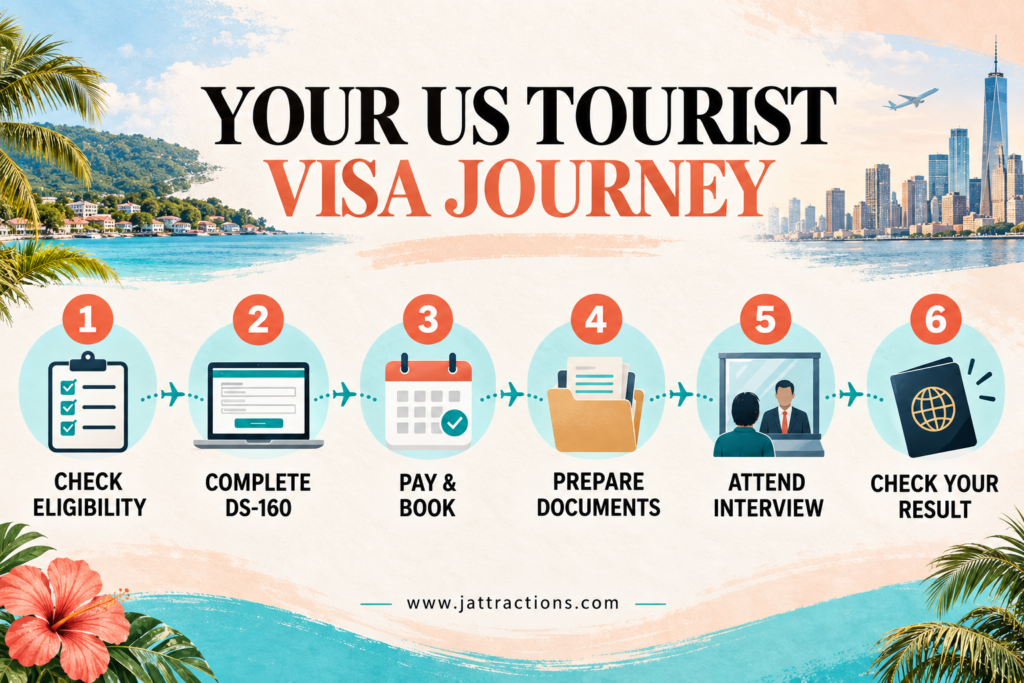
To apply for a US tourist visa from Jamaica, you will need to complete the official B1/B2 application process and, in most cases, attend an interview at the U.S. Embassy in Kingston. Here is how it works:
- Confirm through the official visitor visa guide that a B1/B2 visa matches your reason for travelling.
- Gather the information required to complete the DS-160.
- Complete and submit your application through the official CEAC DS-160 portal.
- Print the barcode confirmation page by following the official DS-160 instructions (Note: You will see the barcode at the end of the application submission in step three.)
- Create an account on Jamaica’s official US visa appointment portal.
- Pay the current non-refundable visa application fee (Note: The B1/B2 fee is currently $185 US).
- Complete your US visa appointment booking through the same official portal.
- Prepare the required and supporting documents.
- Attend your interview at the U.S. Embassy in Kingston, if required.
- Follow the instructions you receive regarding approval, refusal or administrative processing.
That is the US visa application process in its simplest form. Now, let’s look at each stage properly, beginning with whether the B1/B2 is actually the right visa for your trip.
What Is a B1/B2 US Visitor Visa?
Before you begin the US visitor visa application, you need to make sure you are applying for the right US visitor visa. The United States offers several visa categories, and the correct one depends on what you intend to do during your trip.
For most Jamaicans planning a holiday, visiting relatives or attending a short business event (ensure you’re not being paid to attend), the relevant option is usually the B1/B2 visa. It is a temporary nonimmigrant visa, which simply means that you are requesting permission to visit the United States for a limited period rather than relocate there permanently.
| Category | Permitted purposes may include | Does not generally permit |
|---|---|---|
| B-1 | Business meetings, consultations, negotiations, and certain conferences | Regular employment in the US |
| B-2 | Tourism, holidays, family visits, and certain medical treatment | Working or long-term study |
| B-1/B-2 | Eligible temporary business and tourism activities | Immigration or unauthorized work |
Although people often call it a USA tourist visa or American visa, many applicants receive one combined B1/B2 visa that covers eligible business and tourism activities.
What it does not allow you to do is just as important. You cannot use a B1/B2 visa to take ordinary employment, move permanently to the US, or begin a long-term course of study. Travelling for work, university, journalism, or another specialized purpose may require a completely different visa category.
Choosing the correct visa for the USA is the first real step in the application process. Once you know that the B1/B2 matches your plans, you can begin preparing for the cost and application requirements.
How Much Does a US Tourist Visa Cost in Jamaica?
Once you know that the B1/B2 is the right visa for your trip, the next thing to consider is the cost. The current US visa application fee for a B1/B2 visitor visa is US$185.
This is the official government processing fee, and it is non-refundable. That means you will not receive it back if your American visa is refused or if you later decide not to continue with the application.
| Expense | Amount |
|---|---|
| Government application fee | US$185 |
| Agency assistance | Depends on the provider |
| Visa photo | Depends on the photographer |
| Supporting documents | Depends on the bank or issuing organization |
If you use a travel agency, its professional fee will be separate from the US$185 government fee. You are paying for help with organizing and completing the application, not for guaranteed approval. No agency can promise that your visa will be issued.
Visa fees and payment procedures can change, so always confirm the current US visa cost and Jamaican-dollar payment instructions through the official appointment portal before paying.
Check Before Applying If Your Application is Really Ready?
Before we get into the actual application, there are a few things I need you to think about first. You can complete every field on the DS-160 correctly and still be refused if the rest of your application does not convince the officer that you are a genuine temporary visitor.
Understand What the Consular Officer Is Assessing
The biggest question behind a B1/B2 application is simple: if you are given this visa, will you visit the United States and return home when you are supposed to?
The consular officer will not judge your application using one answer or document. They will look at the entire picture, including why you want to travel, how you plan to pay for the trip, what you do in Jamaica, and what responsibilities will bring you back home.
Having relatives in the United States does not guarantee anything. Neither does an invitation letter from someone promising to accommodate or support you. According to the official US visitor visa requirements, applicants must qualify based on their own circumstances and ties outside the United States.
I know everyone wants to find that one document or perfect interview answer that will secure the visa, but it does not work like that. A bank statement, job letter, or land title may support your application, but none of them can guarantee approval on its own.
What Counts as Ties to Jamaica?
When I talk about ties, I mean the genuine parts of your life that give you a reason to return to Jamaica after your trip. That could be your job, an operating business, school or university, children or other dependent relatives, property, a long-term tenancy, professional responsibilities or commitments within your community.
If you are self-employed, for example, you may use your business registration and evidence that the business is genuinely operating. If you are employed, your position and approved leave may help explain why/when you are expected back. If you are studying, your enrolment can form part of that bigger picture.
You do not need to own land, have children, and keep a huge amount of money in the bank all at once. Please do not start collecting random documents because someone told you that one of them guarantees approval. The strongest proof of ties for a US visa is evidence that truthfully reflects the life you already have in Jamaica.
Do You Need Previous Travel History to apply US Tourist Visa from Jamaica?
If it is realistically possible for you to visit another country before applying for your US visa, previous travel may help your overall application. It can show that you have travelled somewhere, followed that country’s rules, and returned to Jamaica.
I travelled before applying, and from my experience, a history of using visas properly can become a helpful part of your travel profile. But I also want to be clear: previous international travel is not an official requirement, and first-time travellers can still receive a USA tourist visa.
Please do not spend money on a trip you cannot afford simply because you think you need stamps in your passport. And definitely do not invent, hide or change your travel history. If you have travelled before, state it accurately. If you have not, be honest about that too.
If you are new to planning trips, starting closer to home can still help you become a more confident traveller. My experience travelling solo across Jamaica for 14 days taught me how to organize transportation, accommodation and a realistic itinerary, although domestic travel does not count as international travel history.
What If You Have a Criminal or Immigration Record?
I cannot stress this enough: answer the security and background questions on the DS-160 truthfully. The form asks about criminal activity, previous immigration violations, and several other matters that can affect your US visa eligibility.
That does not mean every arrest or conviction automatically has the same result. The nature of the incident, the law involved, and the applicant’s individual circumstances all matter. The Department of State provides general information about visa ineligibilities and possible waivers, but it cannot tell you the outcome of your personal case.
If you have been arrested, convicted, deported, caught overstaying, or previously accused of immigration fraud, this is not the time to guess your way through the form. Speak with a qualified US immigration lawyer before submitting anything. Hiding the truth can create a much bigger problem than the original issue.
Should Parents Apply for a Child Before the Child Turns 18?
Here is one tip from my own family’s experience. My father made sure that all of his children applied for a US visa before turning 18, and I received my first visitor visa when I was 16.
At that age, I was still a student, so my circumstances were fairly easy to explain. I had school and my family in Jamaica, and those were natural reasons for me to return home. Some young applicants may even attend their interview in their school uniform, although wearing one certainly does not guarantee approval.
If you have plans to apply for your child, I personally would not leave it until the last minute. However, applying before 18 is not an official shortcut, and it does not mean the visa will automatically be approved. Turning 18 does not make someone ineligible either. Every application is still assessed individually.
Each child who needs a visa must have a separate DS-160, even when a parent completes it on their behalf. Parents should also check the current interview-waiver guidance, as most nonimmigrant applicants now generally require an in-person interview, with limited exceptions.
If you accompany your child, carry your government-issued identification and any required proof of your relationship. Most importantly, make sure your child understands the truthful trip plan in a way appropriate for their age.
Use Only Official US Visa Websites
Now we are ready to begin the actual application, but please be careful. There are fake websites that look almost identical to the official ones. You could end up paying someone who has not submitted anything to the US government and giving them your personal information at the same time.
There are three websites you need to understand.
1. Travel.State.gov
Start with the official US visitor visa overview. This is where you can check visa categories, fees, general requirements, photo standards, official rules and refusal information. Jamaican applicants can also find country-specific visa information through the U.S. Embassy in Jamaica.
2. CEAC
The official CEAC portal is where you start, save, retrieve and submit your DS-160 Jamaica application. After submitting it, you will also print your barcode confirmation page from here.
3. Jamaica’s Official Appointment Portal
Once the DS-160 is submitted, use Jamaica’s official visa appointment portal to create your profile, follow the local payment instructions, complete your US visa appointment booking, and receive updates about your appointment and passport return.
Do not automatically trust the first sponsored result you see. Check the domain before entering passport or payment details. Even if an agency helps you, you are still responsible for ensuring that every answer submitted in your name is accurate.
Step 1: Gather Your Information Before Starting the DS-160
Before you open the official DS-160 form, gather as much of the required information as possible. CEAC estimates that completing the application takes approximately 90 minutes, but it can take longer when you have to stop and search for addresses, dates, or contact details.
I have seen people reach a question about their parents and suddenly realize they do not know their dates of birth. Then they have to pause the application, call their parents, and wait for an answer. Preparing everything beforehand makes the process much less stressful and helps prevent rushed mistakes.
Use this US visa application checklist to get started:
- Your current passport
- Previous passports, where relevant
- Home address, phone number and email address
- Parents’ full names and dates of birth
- Information about your spouse and children
- Current and previous employment details
- Education history
- Proposed travel dates, if known
- The US cities or states you intend to visit
- Hotel, Airbnb, or other accommodation information
- Your US contact’s name, address and phone number, if applicable
- Dates and details of previous visits to the United States
- Recent international travel history
- Previous US visas or visa refusals
- Social-media identifiers requested on the form
- Accurate answers to the background and security questions
Do not guess simply because you want to finish quickly. Exact information is far more important than speed, especially when your passport, employment, and previous travel details can be checked later.
To make learning how to fill out the DS-160 easier, I have prepared a downloadable guide showing the types of questions you can expect.
Prepare Before You Open the DS-160
Download my DS-160 preparation guide and gather your personal, travel, family, and employment information before beginning your application.
Step 2: Complete the DS-160
Once you have gathered your information, you can begin the DS-160 on the official CEAC website. The website may look a little old-fashioned, but it is the correct and functional government portal.
Take your time throughout this stage. The information you submit here will be used during the rest of the American visa process, including your interview.
Select the Correct Application Location
The first thing the DS-160 will ask you to do is select the embassy or consulate where you intend to apply. If you are applying in Jamaica and attending your interview in Kingston, select the correct Kingston location from the list.
Current Department of State guidance recommends applying in your country of nationality or residence. Although it may sometimes be possible to apply in another country, appointment waits can be longer, and it may be more difficult to demonstrate your eligibility when you are applying outside the country where you live.
After choosing the location, enter the security code displayed on the screen and begin the application.
Save Your DS-160 Application ID Number
Please do not rush past the next screen. As soon as you begin, CEAC will generate a DS-160 application ID number. Write it down, take a screenshot and save it somewhere secure.
You will also choose and answer a security question. Save the exact question and answer, not the answer you think you probably entered. You need both the application ID and security answer to retrieve an unfinished application.
The form can time out while you are working. Use the “Next” button at the bottom of each completed page to save your information before moving forward. If you are logged out, you can use the application ID and security answer to return to the form. According to the official DS-160 FAQs, a partially completed application can generally be retrieved through CEAC for 30 days.
Keep these details private. Someone with your application ID and security answer may be able to access sensitive personal information.
Complete the Main DS-160 Sections
The form takes you through several groups of questions, including:
- Personal information
- Address and contact information
- Passport details
- Travel plans
- Travel companions
- Previous US visits
- Your contact in the United States
- Family information
- Work and education history
- Security and background questions
- Social-media identifiers
- Information about anyone who helped prepare the application
The questions you see may depend on your answers. For example, if you have previously visited the United States, you may be asked when you travelled and how long you stayed. If you plan to stay with a relative, you may need their full name, address, phone number, and relationship to you.
This is why I asked you to gather everything first. You do not want to be halfway through the DS-160 trying to remember your employer’s address or calling someone in America to ask for their phone number.
Review Everything Before Submitting
At the end, the DS-160 will give you an opportunity to review your answers. Use it properly. Check the spelling of your name, passport number, dates, employment details, and travel information.
Make sure related answers make sense together. Your intended destination, accommodation, length of stay and person paying for the trip should form one clear and realistic travel plan.
If an agency, family member or another person helped prepare the form, answer the application-preparer question truthfully. Receiving help is not something you need to hide, but you should personally review every answer before the application is submitted.
After submission, save a copy (of all your answers) for your own records and print the barcode confirmation page. You normally take the confirmation page, not a printout of the entire DS-160, to your interview. However, keeping a personal copy of your answers will help you review exactly what was submitted.
Make Sure the DS-160 Barcode Matches Your Appointment
The barcode number on the DS-160 confirmation page must match the number connected to your visa appointment. The U.S. Embassy in Kingston has issued a specific DS-160 barcode reminder asking applicants to check this before attending.
Do not arrive with a confirmation page from one DS-160 while your appointment profile contains the barcode from another. Check the number carefully before your interview so that an avoidable mismatch does not interrupt your appointment.
US Visa Photo Requirements
The DS-160 will ask you to upload a digital photograph, and here is something I did not realize at first: you don’t necessarily have to visit a professional studio to take it.
The last time I helped with an application, we did not have time to go to a photo studio, so we took the picture with a smartphone. We tested it through the DS-160 photo tool; the system accepted it, and we were able to continue with the application.
You can do the same, but the photo still needs to meet the official US visa photo requirements. It should:
- Be recent and in colour
- Have a plain white or off-white background
- Show you facing the camera directly
- Show your full face with a neutral expression
- Reflect your current appearance
- Be free from filters or digital alterations
Eyeglasses are generally not allowed unless you qualify for a limited medical exception.
You can move furniture away from a plain wall, stand in good, even lighting, and ask someone to take the photo with your phone. Just remember that passing the online photo checker does not guarantee that the photograph will receive final acceptance.
If the upload fails, bring a compliant printed photo to your interview. Even if it succeeds, review the latest visa instructions from the U.S. Embassy in Kingston and the instructions included with your appointment confirmation to see whether you should carry a printed photograph as a backup.
Step 3: Pay the Fee and Book Your US Visa Appointment
Once your DS-160 has been submitted and you have saved the confirmation page, move to Jamaica’s official US visa appointment portal. This is the third website I mentioned earlier, and it is where you will pay the application fee and manage your appointment.
Create an account using an email address you check regularly. The portal will ask whether you are managing your own application or completing the process on someone else’s behalf. Enter the DS-160 confirmation number carefully, making sure it matches the barcode on the confirmation page you saved.
Follow the current payment instructions shown on the portal. Depending on the payment method, you may need to wait for the fee to activate before the appointment calendar becomes available. Once it does, select one of the available dates for your US Embassy Kingston visa appointment.
Save the appointment confirmation and monitor the email address connected to your account. This is where you may receive payment confirmation, appointment instructions, and later updates about the return or collection of your passport.
If you need to change the appointment, follow the rescheduling rules displayed in your account. Do not assume you can move it an unlimited number of times, as restrictions can change. Also avoid creating duplicate profiles because this may cause unnecessary account problems.
Some applicants may be told to submit documents without attending an interview, but never assume yours will be waived. A consular officer can still request an interview. Since appointment wait times change regularly, check the current availability before making travel plans. Applicants should also generally apply in their country of nationality or residence.
Step 4: Prepare Your US Visa Interview Documents
Once your appointment is confirmed, do not wait until the morning of the interview to start looking for everything. I recommend organizing your documents the day before (assuming you already have them) in one neat folder so that you know exactly where each item is if someone asks for it.
US Visa Document Checklist: What You Must Bring
Start with the documents listed in your appointment instructions. These will generally include:
- Your current, valid passport
- Your DS-160 barcode confirmation page
- Your visa appointment confirmation
- Your application-fee receipt, if required
- A compliant printed visa photo if requested or if the online upload failed
- Any additional document listed in your appointment instructions
Check your passport before beginning the application and not the night before the interview so you do not suddenly discover that it has expired. You can also review the official visitor visa documentation requirements and the latest visa instructions from the U.S. Embassy in Kingston.
Supporting Documents Needed for a US Visa Interview
Depending on your circumstances, you may also carry:
- An employment and approved-leave letter
- Business registration and evidence that the business is operating
- Recent, genuine financial evidence
- A proposed itinerary and accommodation information
- Evidence showing how the trip will be funded
- School or university documents
- Relevant family or dependent records
- Previous passports and US visas
- Any document specifically requested by the embassy
If you are self-employed, I would especially carry evidence of your business because you may not have a traditional employer tying you to Jamaica. A genuine bank statement, land title, or child’s birth certificate may also help explain your circumstances if the officer asks for proof of ties for your US visa.
However, do not arrive with a suitcase of random paperwork and start pushing every page through the window. Keep your supporting documents organized and provide them when they are relevant or requested.
There is no official minimum bank balance that guarantees approval. Please do not temporarily borrow money to make your account look stronger, and never fabricate a job letter, bank statement, or business document. An invitation letter or Affidavit of Support is also not required for an ordinary tourist application and cannot replace your own qualifications.
What Not to Bring to Your US Embassy Kingston Appointment
When I accompanied my sister to the U.S. Embassy in Kingston, I thought I would be able to go inside with her. I could not. I had to remain outside and hold her bag because she was not allowed to take it into the embassy either.
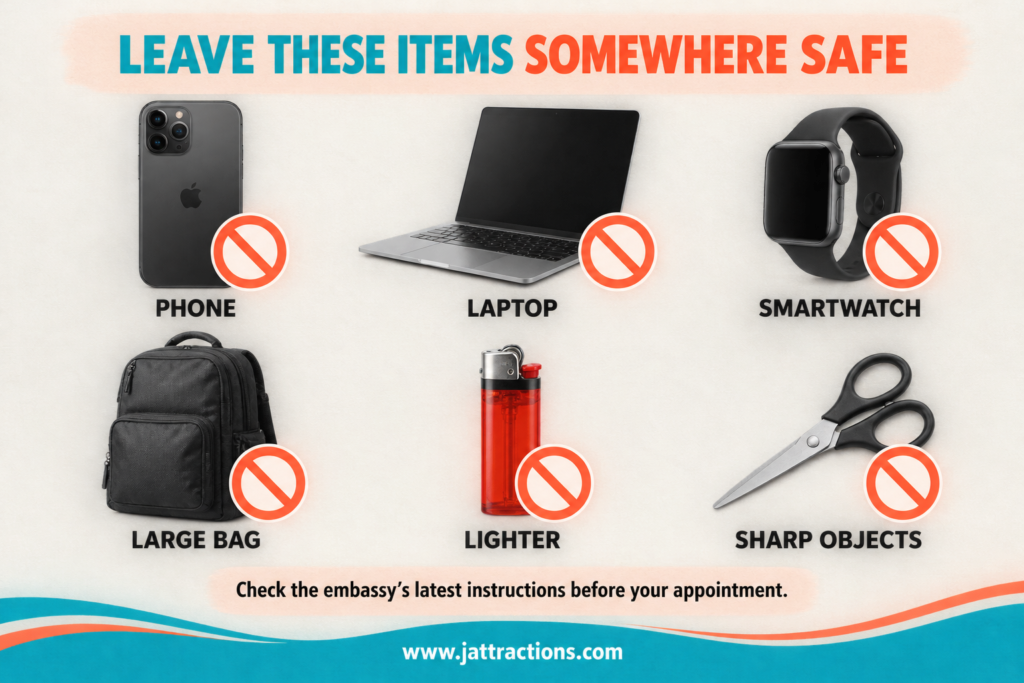
To make your appointment easier, carry only the documents you need and leave prohibited items somewhere safe. These may include:
- Cellphones, computers and tablets
- Smartwatches and other electronic devices
- Large bags
- Large umbrellas
- Knives, scissors and other sharp objects
- Weapons of any kind
- Lighters and matches
- Any additional restricted item listed by the embassy
I have also seen someone arrive with a smartwatch, thinking that an ordinary watch was allowed, only to be sent out of the line to leave it elsewhere. Do not assume that storage will be available at the embassy.
Only the applicant and other people permitted under the appointment rules can enter. A parent or guardian may be allowed when accompanying a minor, but other relatives and friends should expect to wait outside.
Security rules can change, so review the official Kingston prohibited and permitted items list shortly before your interview.
What Should You Wear to a US Visa Interview?
Please dress appropriately for your US visa interview. You do not need to buy an expensive suit or look like you are attending a wedding. Just wear something clean, comfortable and suitable for an official appointment. I personally recommend dressing modestly and choosing an outfit that allows you to feel confident rather than distracted or uncomfortable.
There is no official outfit that can increase your chances of approval. Looking presentable may help you feel prepared, but clothing cannot compensate for inaccurate information or an application that does not clearly make sense.
Eat a proper breakfast before leaving as well. Between entering the embassy, completing security checks, and waiting for your turn, the appointment may take longer than expected. You need to be able to think clearly when the officer begins asking questions.
Finally, arrive according to the timing in your appointment instructions. There is no benefit in arriving extremely early if the embassy has told you when to report.
US Tourist Visa Interview Questions and Tips for Jamaican Applicants
The interview is the part that makes most applicants nervous, but please remember that the officer is not expecting a dramatic speech. They want to understand why you are travelling, whether your plans are credible, and whether you qualify for the visa you requested.
Be calm, listen properly, and know your own application. You should not need to perform or pretend to be someone else to answer questions about your life and travel plans.
Review Your DS-160 Before the B1/B2 Visa Interview
Before your interview, read through the answers submitted on your DS-160. Whether you completed it yourself or received help from an agency, you need to know what was written in your name.
Pay particular attention to:
- Your intended travel dates
- The places you plan to visit
- How long you intend to stay
- Your accommodation
- Your US contact, if applicable
- Who will pay for the trip
- Your employment or business information
- Your previous travel and visa history
The officer may ask you a question even though the answer is already on the form. That is normal. They may be checking whether you understand your application and whether your answer is consistent with what was submitted.
Do not memorize an artificial script. If your hotel, dates or another genuine detail changed after you submitted the DS-160, explain the change honestly. Never invent an answer simply because you are afraid that the truth will not match the form.
Common US Visa Interview Questions in Jamaica
Every interview is different, so nobody can give you an exact list of questions you are guaranteed to hear. However, common US tourist visa interview questions may include:
- Why do you want to visit the United States?
- Which cities or states are you planning to visit?
- How long do you intend to stay?
- Who will pay for your trip?
- Where will you be staying?
- Do you know anyone in the United States?
- Do you have relatives living there?
- What do you do for work?
- Do you own or operate a business?
- How long have you worked in your current position?
- Have you travelled internationally before?
- Have you previously visited the United States?
- How long did you stay during your previous visits?
- Have you ever been refused a US visa?
- What responsibilities require you to return to Jamaica?
The officer may ask only a few questions, or they may ask for additional details. A short interview does not automatically mean approval or refusal, so do not try to judge the result while it is happening.
How to Answer US Visa Interview Questions Confidently
My biggest US visa interview tip is this: answer the question you were asked, then stop.
If the officer asks for your name, give your name. If they ask where you will stay, provide the place and address. You do not need to add three unrelated stories that may confuse the answer or lead the conversation somewhere it did not need to go.
That does not mean becoming robotic or hiding information. It means listening carefully, telling the truth, and keeping your answer relevant. Never conceal relatives, previous refusals, overstays, or other immigration issues. If you do not understand a question, politely ask the officer to repeat or explain it.
Speak clearly and maintain natural eye contact if you are comfortable doing so. Confidence does not mean pretending you are fearless. It means understanding your own plans well enough to explain them without guessing.
Also remember that the interview windows may not feel very private, and other applicants nearby may be able to hear parts of the conversation. Focus on your own interview rather than worrying about who is listening.
B1/B2 Interview Preparation When Applying With a Child
If a child is applying, make sure they understand the truthful trip plan in language appropriate for their age. They should know where they are going, who they are travelling with and, where appropriate, who they will be visiting.
The parent and child should not provide contradictory answers, but please do not coach a child to memorize a fabricated story. The goal is simply to ensure that everyone understands the same genuine plan.
A parent or guardian accompanying a minor should carry a valid government-issued ID, such as a passport (always take the passport to be safe), driver’s licence, or other accepted identification. I know of a parent who arrived without the required ID and had to leave the line to retrieve it before returning. Bring proof of your relationship to the child if the embassy requires it, along with any other documents listed in the appointment instructions.
Does the US Visa Application Check Social Media?
Yes, the DS-160 asks most US visa applicants to provide certain social-media handles used during the period specified on the form. This can include usernames or handles connected to platforms such as Facebook, Instagram, X, LinkedIn, and YouTube. It asks for your handles, not your passwords.
I can tell you from personal experience that background checks are not something to dismiss. During secondary screening at a US airport, officers searched for information about me, my company, and my background while I was sitting there. That does not mean every officer manually reads every post made by every applicant, but you should assume that information connected to your identity may be reviewed.
When completing the DS-160 social-media information, disclose what the form requests truthfully. Do not hide an old account simply because you no longer use it, and do not provide a false username.
I also would not advise you to begin deleting posts or erasing accounts in an attempt to manipulate a US visa social-media check. You can remove any harmful posts you might have. However, removing something from your profile does not guarantee that copies, screenshots, or archived records no longer exist. More importantly, concealing requested information or making a material misrepresentation can create a much more serious immigration problem than an ordinary visa refusal.
You can read the Department of State’s official information about social-media identifiers before completing this part of the form.
If you are genuinely concerned that something in your online history could affect your eligibility, speak privately with a qualified US immigration lawyer instead of guessing, deleting information, or asking strangers online what to do.
What Happens After the US Visa Interview?
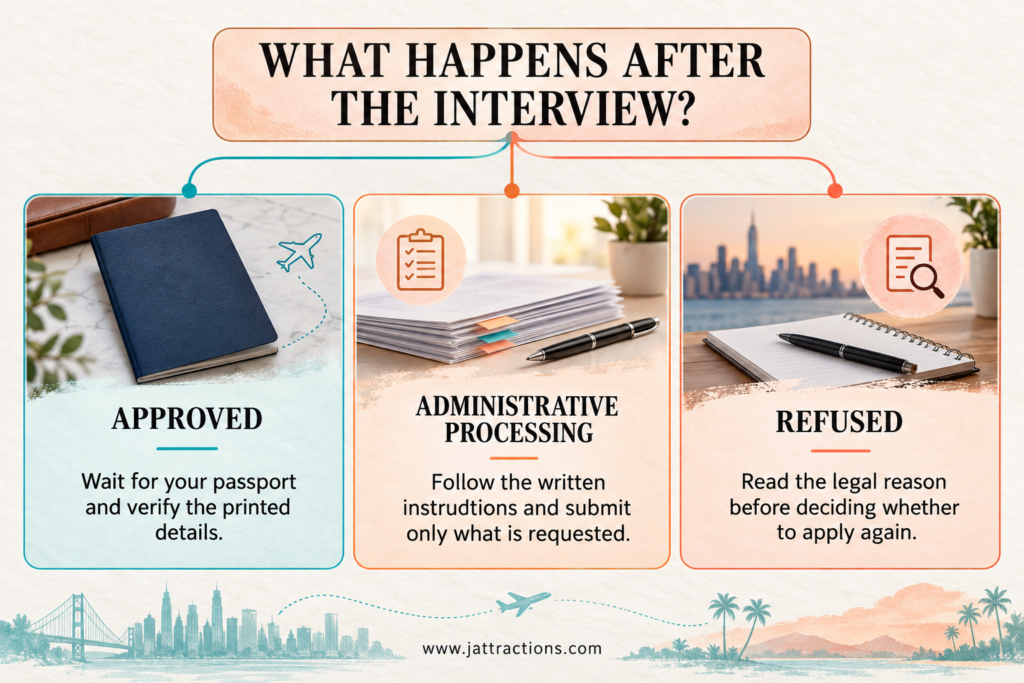
In many cases, the consular officer will tell you the result or next step at the end of the interview. However, not every case falls neatly into “approved” or “denied.” Your application may be approved, refused, or placed into additional processing.
During my own experiences in Jamaica, different-coloured papers were sometimes used to communicate the outcome. However, you should not treat a white or green paper as a universal approval or refusal system. Procedures and paper colours can change. What matters is the written decision, the section of law mentioned, and the instructions the officer gives you.
What Happens After US Visa Approval?
If your US visa is approved, the embassy will generally keep your passport so the visa can be printed inside it. The officer or appointment system will provide instructions explaining how the passport will be returned or where it can be collected.
Monitor the email address connected to your appointment account. In my experience, this is where the updates arrive when the passport is ready, which is why I told you earlier to use an email address you actually check.
You may hear people say that every approved passport will be ready within one week, but do not depend on that promise. Timelines can vary, and even an application that appears approved at the interview may require additional processing before the visa is issued.
Do not buy a non-refundable flight simply because the officer said the application was approved. Wait until the visa has been issued, your passport has been returned, and you have checked that all the printed information is correct.
What Is Administrative Processing for an American Visa Application?
Some applications need further review after the interview. A refusal under Section 221(g) may mean that the officer needs an additional document or that the application requires administrative processing.
Read the written instructions carefully. If the embassy asks for a particular document or piece of information, submit exactly what was requested through the method provided. Do not send random additional evidence hoping that something will help.
Administrative processing times vary from case to case. The Department of State’s administrative processing guidance explains that the timing depends on the individual circumstances of the application.
What Happens After a US Visa Refusal Under Section 214(b)?
If your American visa application result is a refusal under Section 214(b), there is no formal appeal process. The officer will normally provide a written notice identifying the legal reason for the decision.
You are allowed to apply again, but you will generally need to complete a new DS-160, pay another non-refundable application fee, and attend another interview. Read the Department of State’s official visa-refusal guidance before starting over.
Reapplying immediately with the same information and circumstances may produce the same result. Before paying again, consider whether something important was missing, whether your circumstances have genuinely changed, or whether you can now explain your travel purpose and ties more clearly.
A refusal is disappointing, and I am not going to pretend it is not, but do not allow panic to push you into submitting false information or paying someone who promises a guaranteed approval the next time.
How Long Is a US Tourist Visa Valid for Jamaicans?
Many Jamaican applicants receive a multiple-entry B1/B2 visa valid for up to 10 years. However, check the visa printed inside your passport because its expiry date and number of permitted entries are what apply to you. Validity can differ by nationality and visa category, which you can confirm through the official visa reciprocity tables.
These three terms are easy to confuse:
| Term | Meaning |
|---|---|
| Visa validity | How long you can use the visa to travel to a US port of entry and request admission |
| Number of entries | Whether you can use the visa for one, two, or multiple trips |
| Authorized stay | How long U.S. Customs and Border Protection (CBP) allows you to remain after a particular entry |
A 10-year American visa does not mean you can enter the United States and remain there for 10 years. It means you may use that visa to request entry during its validity, subject to the number of entries printed on it.
Even a valid visa does not guarantee admission. A Customs and Border Protection officer decides whether you can enter and how long you may stay during each visit. Do not automatically assume you have been given six months.
After arrival, check your electronic record through the official I-94 website. The “admit until” date on that record controls your authorized stay. Remaining beyond it can affect future visits and immigration applications.
Because visa validity varies by nationality and category, check the official visa reciprocity tables for current information.
Booking Your Flight From Jamaica to America
Once your visa has been issued and your passport is back in your hands, you can finally start looking for flights. My first stop is usually Google Flights because it gives me a quick view of available dates, airlines, and prices.
If you are searching from Jamaica, Google may automatically display the fare in Jamaican dollars. I sometimes change the currency to US dollars so I can compare the original price without relying entirely on the platform’s conversion rate.
If the fares still look too high, I check Skyscanner and may also compare the route through Expedia. After finding a suitable flight, I check the airline’s own website before paying. Sometimes the airline offers a better price or clearer support if something goes wrong.
Do not compare the headline fare alone. Check:
- Baggage allowances and fees
- Cancellation and change conditions
- Airport and connection times
- Transit-visa requirements
- Whether the ticket includes every part of the journey
The cheapest third-party listing is not always the best deal once bags and restrictions are added.
You should also keep proof of your return or onward flight accessible. A border officer may ask when and how you plan to leave the United States.
Arriving in America: A US Visa Does Not Guarantee Entry
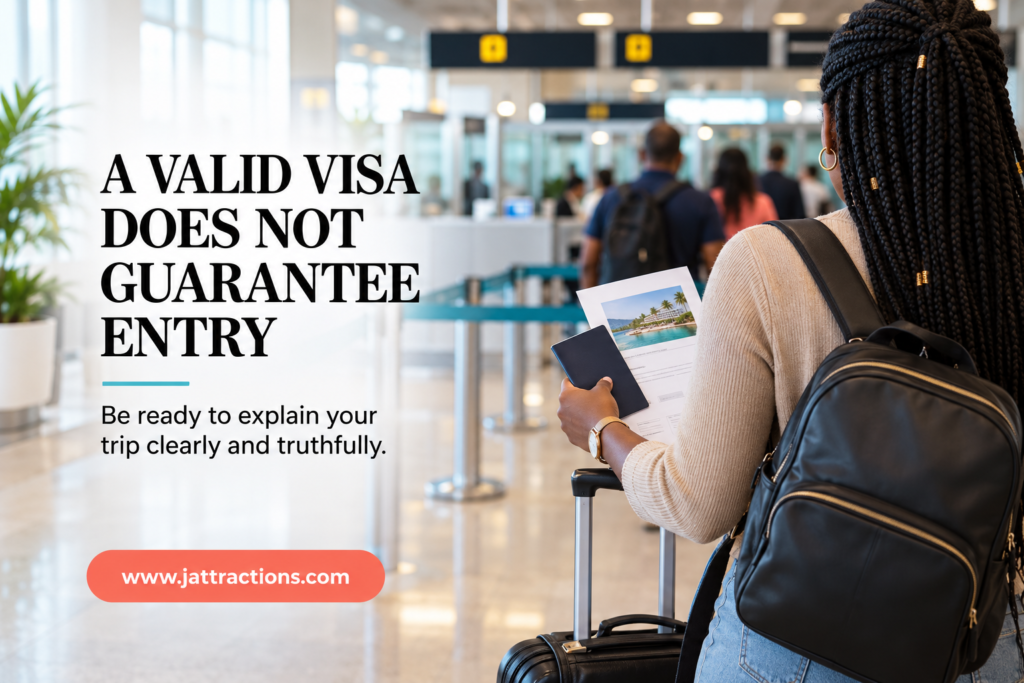
Getting the visa is a major step, but it does not automatically guarantee that you will be allowed into the United States. It permits you to travel to a US port of entry and request admission. The final decision belongs to a Customs and Border Protection officer at the airport.
When entering the US with a tourist visa, the officer may ask:
- Why are you visiting?
- Where are you staying?
- How long will you remain?
- Who is paying for the trip?
- When are you returning to Jamaica?
- Do you have enough money for your visit?
Keep your accommodation address, host’s contact information, and return-flight details somewhere you can access easily. Treat US airport immigration almost like a second visa interview: listen carefully, answer truthfully, and do not add unrelated information.
I have personally been sent to secondary inspection multiple times. Officers have researched my company and asked me similar questions in different ways to see whether my answers remained consistent. It can feel intimidating, but being sent for additional questioning does not automatically mean you have committed an offence.
My practical advice is to understand your own trip, remain calm, and answer accurately. Never joke about weapons, drugs, illegal work, or airport security. This is not the place for that kind of humour.
Once admitted, check your record through the official I-94 website and confirm the date by which you must leave. You can also see your entire travel history over the last 10 years.
If you are travelling from Jamaica to America and connecting to another US flight, you will generally clear immigration and customs at your first US airport. You may also need to collect your checked baggage and recheck it for the domestic connection. Follow the signs and airline instructions because procedures can vary by airport and itinerary.
US Customs Rules for Food and Agricultural Items
After immigration and baggage collection, you will pass through customs. This is where officers may ask what you are bringing into the country and may inspect your luggage.
Be particularly careful with food and agricultural products. Restrictions can apply to:
- Meat and meat products
- Fresh fruit and vegetables
- Plants and cuttings
- Seeds
- Soil
- Other homemade or agricultural items
Do not assume something is allowed simply because it is cooked, dried, packaged, or something you regularly carry when travelling. Whether an item can enter the United States may depend on the product itself, how it was prepared and its country of origin.
If you are unsure, declare it. Declaring an item does not automatically mean you will be punished or that it will be confiscated. It allows the officer to inspect it and decide whether it is permitted. Trying to hide a restricted product can lead to confiscation and possible penalties.
Before packing, check the current CBP guidance on agricultural items and the USDA information for international travellers. Rules can change when pests, animal diseases, or other agricultural risks emerge.
Once you clear immigration and customs, you are officially through the arrival process and ready to begin your trip.
Can a US Visa Help Jamaicans Visit Other Countries?
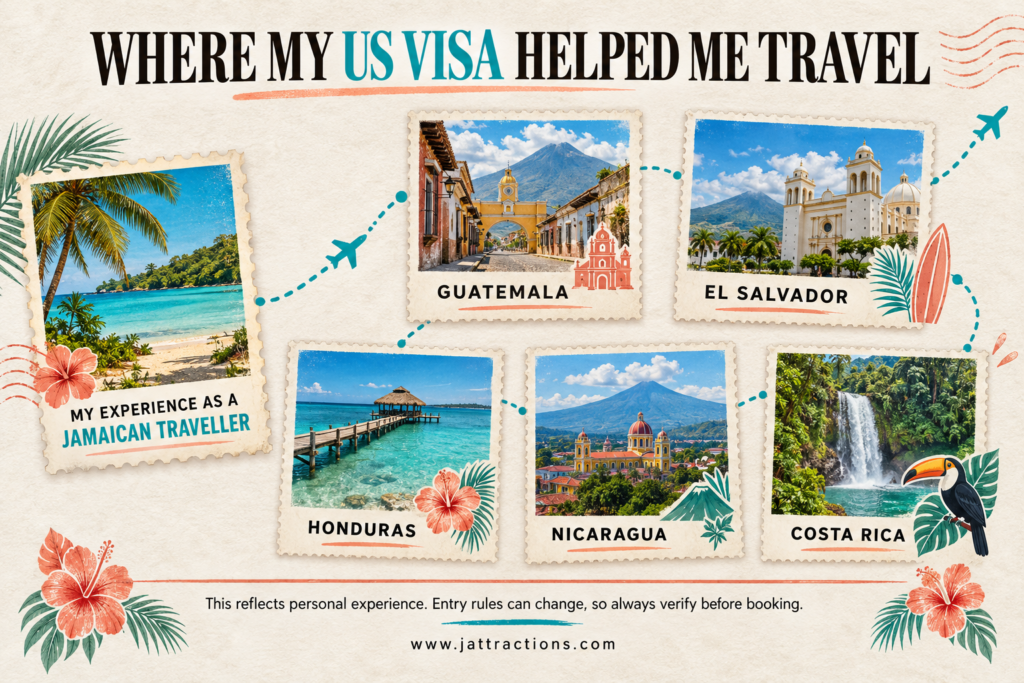
One benefit I discovered after receiving my US visa is that it also made travelling to certain other destinations easier. Some countries waive their usual visa requirement for travellers of particular nationalities if they already hold a valid US visa.
In my case, my US visa helped me travel to Guatemala, El Salvador, Honduras, Nicaragua and Costa Rica without completing five separate visa applications. That saved me a great deal of time, money, and paperwork while travelling through Central America.
However, I want to be very clear: this was my personal experience under the entry requirements in place when I travelled. A US visa does not automatically give every Jamaican free access to those five countries or to any other country.
Eligibility can depend on:
- Your nationality
- Whether your US visa permits multiple entries
- Whether you have already used the visa to enter the United States
- How much validity remains on the visa
- The purpose and length of your intended visit
- Other passport, ticket, or financial requirements
Immigration policies can change, sometimes with little warning. Before booking anything, check the destination’s official immigration website and confirm the requirements with your airline. Do not rely entirely on my previous trip, an old blog post, or something someone told you online.
I will cover the current rules in more detail in my guide to Countries Jamaicans Can Visit With a Valid US Visa.
Travelling Around the USA: Flights, Trains and Accommodation
One of the reasons I enjoy travelling around the USA is that every state feels as though it offers something different. After almost 15 years of solo travel, I have visited 24 states plus Washington, D.C., and I still have plenty left to explore.
For longer distances, domestic flights are usually the fastest option. You can also travel between certain cities using Amtrak, Greyhound, or other intercity bus companies. Depending on your destination, renting a car may give you more flexibility, while major cities often have their own trains, buses, and local public transportation systems.
For accommodation, I usually compare options across Airbnb, Booking.com and Expedia. Do not compare the nightly price alone. Check taxes, cleaning fees, location, cancellation conditions, and how you will travel from the property to the places you want to visit.
This is not a complete Expedia travel guide to all 50 states, but those platforms are useful starting points when planning your first US trip.
Can You Apply for a US Tourist Visa From Jamaica Without an Agent?
Yes, you can complete the entire process of US tourist Vvsa from Jamaica yourself. The US government does not require you to use a travel agency, and the official websites linked throughout this guide provide the forms and instructions you need.
If you are comfortable reading the questions, gathering your information, and checking every answer carefully, go right ahead and apply independently. That is also why I created my DS-160 preparation guide: so you can see what information you may need before opening the form.
However, not everyone feels confident completing a detailed application alone. An agency can help you understand the steps, organize your information, and avoid simple mistakes that might happen when you are rushing or unfamiliar with the process.
I now operate a registered travel agency and provide US visa application assistance for people who would prefer that support. What I cannot do, and what no honest agent can do, is influence the consular officer or guarantee that your visa will be approved.
Even when someone helps you, the information must come from you. Review every answer before submission because the application is still being made in your name.
If you feel comfortable completing the process yourself, download my DS-160 preparation guide and use the official resources linked in this article. If you would prefer help organizing your information and working through the application, you can contact my registered travel agency.
Frequently Asked Questions About the US Tourist Visa From Jamaica
How Much Is a US Tourist Visa in Jamaica?
The current B1/B2 visa application fee is US$185. It is non-refundable, even if the visa is refused. Fees can change, so verify the amount on the official US visa fee page before paying.
How Long Does It Take to Get a US Visa Appointment in Jamaica?
There is no fixed waiting period. Appointment availability changes according to demand and the embassy’s capacity. Check the current estimate using the Department of State’s global visa wait-time tool, then sign in to Jamaica’s official appointment portal to view available dates.
Can I Get a US Visa Without Previous Travel History?
Yes. Previous international travel is not an official requirement for a B1/B2 visa. A history of travelling and returning as required may support the overall application, but first-time travellers can also be approved.
How Much Money Do I Need in My Bank Account for a US Visa?
There is no published universal minimum bank balance that guarantees a US visa. Your available funds should make sense in relation to the cost and length of your trip. The officer may also consider who is funding the visit and your overall circumstances.
Do I Need to Buy a Flight Before My US Visa Interview?
No. The Department of State advises applicants not to make final travel plans or purchase tickets until the visa has been issued. You can prepare a proposed itinerary without buying a non-refundable flight.
Can an Agent Guarantee My American Visa?
No. An agent may help you understand the process, organize your information, and complete the application, but they cannot influence the consular officer or guarantee approval. Be cautious of anyone who promises otherwise.
What Happens if My US Visa Is Refused?
The next step depends on the legal section written on your refusal notice. A refusal under Section 214(b) cannot be appealed, but you may submit a new application, pay the fee again, and attend another interview. Read the official visa-refusal guidance before reapplying.
Can I Work in the United States on a B1/B2 Visa?
A B1/B2 visa does not authorize ordinary employment in the United States. If your actual purpose is to work, you may need a different visa category.
Does a 10-Year US Visa Let Me Stay for Six Months on Every Trip?
No. A 10-year visa allows you to request admission while the visa remains valid. U.S Customs and Border Protection decides how long you can stay after each entry. Check the “admit until” date through the official I-94 website rather than assuming you have six months.
Should I Delete Social-Media Posts Before Applying?
Do not delete or conceal information in an attempt to manipulate visa screening. Provide the social-media identifiers and other information requested on the DS-160 truthfully. If you believe your online activity could create a legal eligibility issue, speak with a qualified US immigration lawyer.
Can I Use a Smartphone Photo for My US Visa Application?
Yes, a smartphone photo may be used if it meets all the official US visa photo requirements. However, passing the online upload test does not guarantee final acceptance.
Prepare Carefully and Be Honest
I received my first US visa when I was 16, and since then, I have spent almost 15 years travelling solo across 24 states and Washington, D.C. If there is one thing that experience has taught me, it is that the process feels far less intimidating once you break it into individual steps.
You do not need a supposedly perfect answer or an enormous folder filled with every document you own. You need a truthful, realistic application that you understand. Whether you complete the DS-160 yourself or receive help from an agency, read every answer before it is submitted in your name.
No guide, bank statement, interview technique, or travel agent can guarantee that your visa will be approved. What you can do is prepare carefully, use the official websites, and avoid unnecessary mistakes.
If you do not want to handle the application yourself, my travel agency can help you organize your information and work through each stage of the application.
Get Help With My US Visa Application
Planning this trip? Save this guide on Pinterest for later!

Submit A Comment